
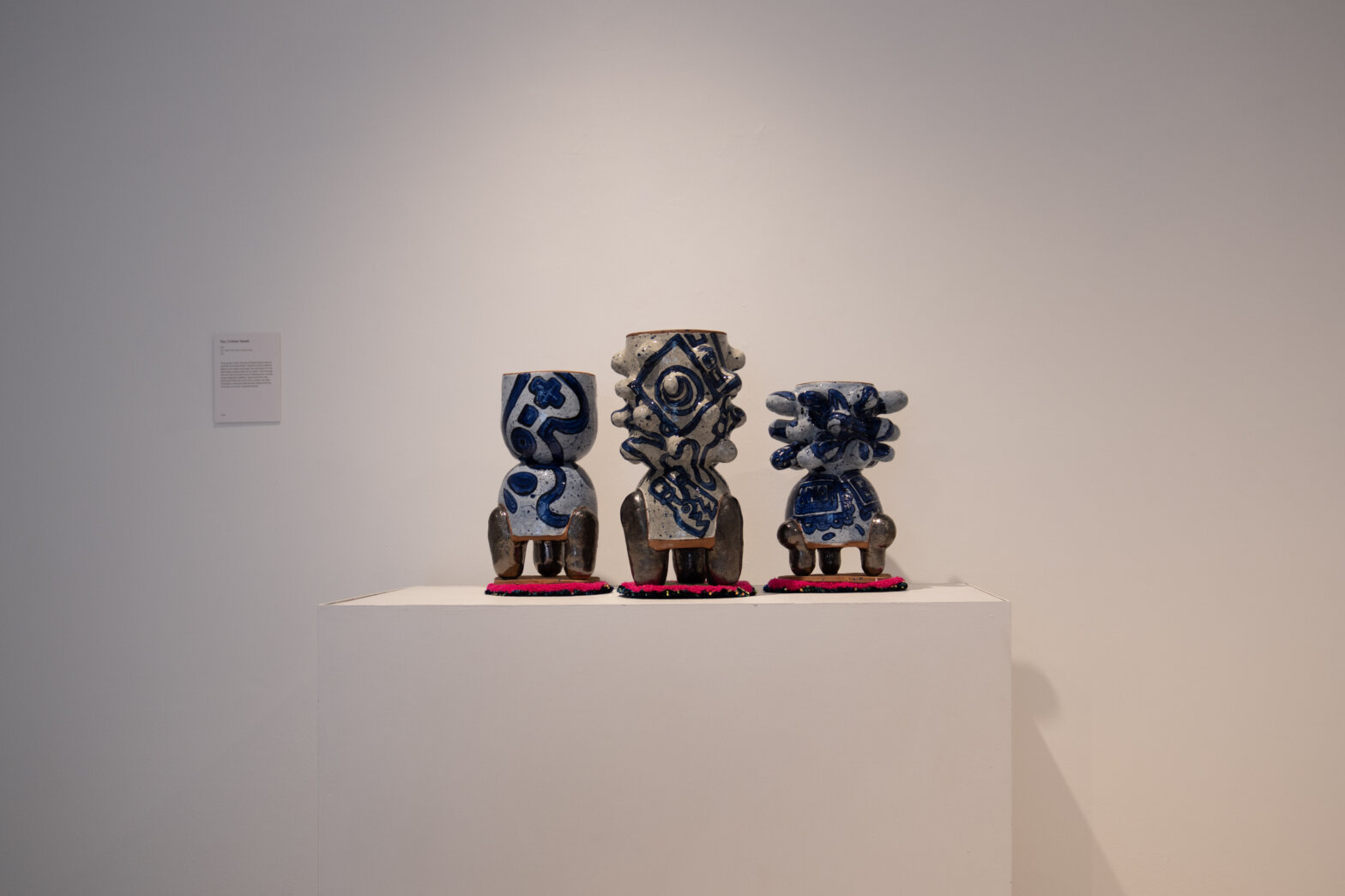
Exploring the harsh beauty of the Southwest and the complexities of generational inheritance, multidisciplinary artist Dina Perlasca brings her striking new exhibition, “Desert Home/ Casa del Desierto,” to Western New Mexico University. The collection showcases ceramics, textiles, clay paintings and domestic materials to examine how regional landscapes mirror personal history, resilience and survival.
Drawing on her upbringing in the Paso del Norte Region, where Ciudad Juárez, Mexico and El Paso, Texas meet along the U.S.-Mexico border, Perlasca uses the desert ecosystem as a psychological landscape. Just as native desert plants and animals of the Paso del Norte Region develop spikes and other strategies for survival in harsh conditions, Perlasca reflects on the protective mechanisms women must build when navigating traditional Hispanic cultural expectations.
“The desert, as a landscape, is a metaphor to my own life,” Perlasca said. “I take a lot of inspiration in the landscape and in the plants. All the beautiful plants here are amazing and they have beautiful green sage cacti and hot pink and orange flower colors, but they also have spikes, and they have ways of protecting themselves.”
The exhibition also addresses the quiet struggles of family dynamics, comparing repetitive generational patterns to themes found in Gabriel García Márquez’s classic novel, “One Hundred Years of Solitude.” By examining her Mexican, Italian, Spanish and Yaqui heritage, Perlasca investigates how unexpressed trauma and historical silences can pass through generations, particularly affecting women raised to prioritize everyone else before themselves. Through her sculptural work, Perlasca aims to offer visitors a sense of safety, validation and shared belonging.
“I make art because I have to. I was born an artist and making art is how I navigate the world. As a woman and an artist, I’ve come to understand that sharing my work gives the viewer a sense of belonging, recognition and safety. I hope viewers see themselves in my work and know that they are not alone.”
“Desert Home/Casa del Desierto” highlights the tactile memory of clay alongside domestic objects, honoring the creative legacy of Perlasca’s grandmother, Geraldina, who customized her living spaces as an act of autonomy and artistic expression. By merging Mesoamerican ancestral motifs with contemporary forms, the artist constructs modern idols and utilitarian objects designed to offer comfort and cognitive understanding.
Ultimately, the exhibition serves as a mirror for viewers navigating their own healing journeys. Perlasca emphasizes that healing is non-linear and that acknowledging past struggles is a lifelong process rather than a destination.
“Healing is not linear. I’ve learned that it isn’t something that happens once and then stays with you forever. I used to believe there would be a magic potion, or that I would find something that would heal me completely. But that never happened for me. Now, I understand that healing is a process. It’s okay not to be okay at all times and I am at peace with that.”
“Desert Home/Casa del Desierto” is on view at the Francis McCray Gallery of Contemporary Art at Western New Mexico University through September 24, 2026. Gallery hours are Tuesday–Friday, 10:00 a.m. to 4:00 p.m.