
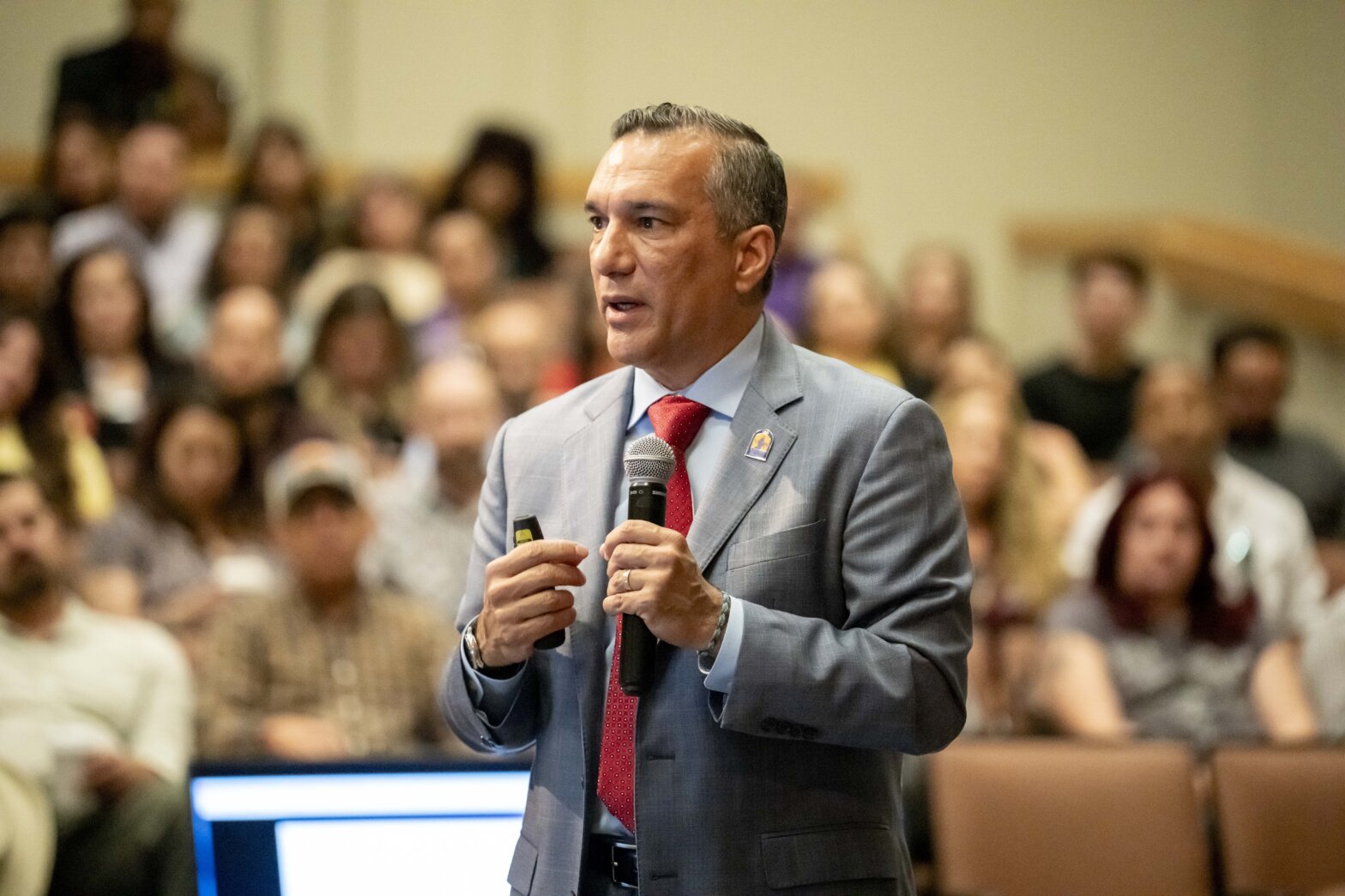
Western New Mexico University welcomed faculty, staff and leadership to campus for its annual Fall Convocation, framing the start of the academic year around collaborative vision, strategic transformation and collective impact.
President Jose E. Coll spoke to the assembly roughly 30 days into his tenure. Recognizing the rapid transition into the term, he emphasized that his immediate priority was establishing a dialogue across campus rather than delivering a standard administrative briefing.
Coll expressed appreciation of New Mexico’s commitment to higher education, specifically highlighting the Opportunity Scholarship’s meaningful impact on the state’s students. He framed the state’s substantial financial support as one that grants the university the leverage to invest directly in student success, workforce development and community growth.
Rather than exclusively targeting high school seniors, Coll highlighted state data showing 324,000 adults in New Mexico who started higher education but never finished. He urged the university to re-engage this specific group, noting that helping these adults complete a degree or certificate directly shifts economic mobility and social well-being in the region.
Coll outlined a collaborative planning framework developed to position the university to ensure long-term sustainability over the academic year. Rather than imposing a top-down mandate, he announced that the university will spend the year engaging in broad-based conversations to establish a measurable three-year strategic plan, set to launch in Fall 2027. This plan will focus on establishing key result areas to directly align strategic priorities with annual budget investments.
Addressing more extensive trends in higher education, Coll urged the campus community to readily adjust to shifting demographic realities, such as declining national birth rates and changing student needs, drawing comparisons to past corporate failures to innovate. “We cannot sit back and wait to see how higher education will define our future,” Coll said. “We have to define our future.”
Key areas of focus in his address spanned academic pathways, community alignment, artificial intelligence and overall student retention. Coll urged faculty to review curricula to support four-year or optional three-year graduation pathways. Citing Grant County’s 21% poverty rate, he called for balanced investments in liberal arts and vocational training to drive regional economic mobility. He also encouraged embracing AI as a key resource for workforce readiness rather than an academic threat. Finally, Coll framed institutional progress around four central pillars—Access, Relevance, Shared Governance and Completion—noting that student success depends on every department across campus.
Following his remarks, Coll fielded questions from floor attendees and virtual participants, addressing topics including Hispanic-Serving Institution outcomes, transfer student pathways, virtual faculty representation on university working groups, and future budget alignments for strategic priorities.
Beyond the presidential address, the Fall Convocation agenda featured several key campus updates and programmatic sessions. The program opened with welcoming remarks from university leadership and governing board members, followed by briefings from faculty and staff association leaders regarding forthcoming initiatives for the academic year. Attendees also received operational and safety guidelines from Campus Police, along with mandatory Title IX and compliance updates covering university regulations and support reporting. The event wrapped up with an address regarding regional educational partnerships and related goals.